We are a revivalist tradition that values direct, reciprocal relationships with our deities in the present time. You may find some of their names to be familiar, because some of them were borrowed into other pantheons long after the time when the Minoans flourished on Crete. But our experience of them as Minoan deities is distinct from the way they are portrayed in other, later pantheons. So keep an open mind as you explore the Minoan family of deities.
The way these deities weave together the fabric of existence involves a number of different types of relationships, including parent-child and sibling-to-sibling connections. This includes sets of twins and triplets, along with members of the pantheon who are individual deities on some occasions and faces of their parents or each other on other occasions. They form a large and multi-faceted family full of beautiful complexity and flowing changes. Together, they combine to bringing the Mysteries into being.
Our deities’ stories are woven into our sacred calendar, which is based on the seasonal cycles of the Mediterranean, where the Minoans lived and worshiped for centuries on the island of Crete.
This is the family of deities that we have a relationship with because it has become clear to us through practice and experience that this is the way the deities want us to interact with them here and now. We make no claim that this was the way the Minoans arranged their pantheon.
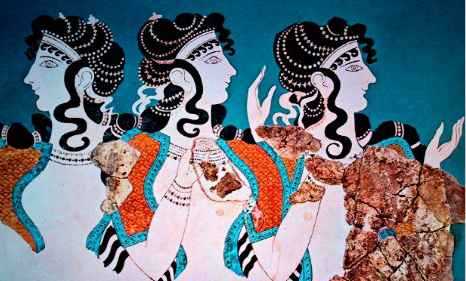
We have five mother goddesses altogether, but three of them — a trio we call the Great Mothers — have a special place as the matriarchs of the pantheon. They represent the three sacred realms of Land, Sky, and Sea.
Rhea: (RAY-ah) The Minoan Earth Mother Goddess, the island of Crete itself and the representative of the sacred realm of Land. Rhea is the name most people know her by, but some of us call her Ida (ee-DAH), another of her ancient names, as well as the Mountain Mother; there are several mountain peaks on Crete that are sacred to her. Find out more about her here.
Therasia: (teh-RAH-see-ah) The very ancient but new-to-us Minoan Sun Goddess. She represents the sacred realm of Sky and was probably the original harbinger of the seasons and apportioner of the solar year. As well as the Sun, volcanoes and hot springs are hers. Find out more about her here.
Posidaeja: (poh-see-DYE-ah) Grandmother Ocean, out of whose waters the beautiful island of Crete rises. Representative of the sacred realm of Sea. She was very important to the Minoans, who relied on the Mediterranean Sea both for food and as a means of travel and trade. Find out more about her here.
The other two mother goddesses have realms that are a little less material but no less beautiful:
The Serpent Mother: This enigmatic figure is an Underworld or Otherworld goddess. She moves between the spaces of material reality. The Snake Goddess figurines that we sometimes use to represent her are iconic of Minoan art and religion. Find out more about her here.
Ourania: (oh-RAH-nee-ah) Great Cosmic Mother-of-All. She is the starry night sky, the fabric of the universe itself. If you’re into quantum physics, she’s the quantum foam. Some of us experience her as a great black vulture, a representation that may go back as far as the home of the Minoans’ ancestors in Neolithic Anatolia. Find out more about her here.
The Mothers have children, of course. All the Minoan deities are their children — and so, in a sense, are all of us who have sacred relationships with them. But specifically, the Three Mothers each have a Daughter and a Son. Here are the Daughters:
Ariadne: (ah-ree-AHD-nay, ay-ree-AD-nee) Who hasn’t heard of Ariadne and her ball of thread? But the Greeks got her story wrong (perhaps on purpose). She wasn’t a human girl, but a goddess. Her Labyrinth wasn’t a cage for a monster, but a sacred ritual dance and a path for spiritual growth along with the Minotaur, who turns out to have been a god after all (he’s on this list a little farther down, among his fellow Horned Ones). Ariadne also plays a major role in the Minoan version of the Eleusinian Mysteries. Instead of Demeter and Persephone, the Minoan version tells the story of Rhea and Ariadne, with no abduction involved. So yes, Ariadne is Rhea’s daughter. Find out more about her here.
Arachne: (ah-RACK-nee) This Spinner of Fate was “demoted” to the status of mere mortal in the tale the Greeks told, but we know her as a fate goddess, daughter of our Sun Goddess Therasia. As you might guess, the ancient skills of spinning and weaving are sacred to her. It’s her thread that Ariadne famously uses in the Labyrinth.
Antheia: (an-THAY-ah) The Star of the Sea is Posidaeja’s daughter as well as the Minoan face of Aphrodite, an ancient goddess who pre-dates the Greeks. Though Aphrodite herself hails from Cyprus, she appears to have been imported to Crete in Minoan times. She helps us find beauty in the everyday world, especially in places we don’t expect to find it. She is also the Divine Lighthouse, protecting ships from danger along the seashore, the liminal area that is her realm.
And the Sons:
Tauros Asterion: (TOH-ros ah-STAY-ree-on) The starry bull is an ancient god, son of the Earth Mother. We connect him with the constellation Taurus. Zagreus and the Minotaur are two of his faces from Minoan times, but we approach him as Tauros Asterion when we want to build a relationship with this earthy-starry being who embodies “as above, so below.”
Korydallos: (koh-ree-dah-LOS) The Lark, son of the Sun goddess, was a surprise discovery via research into the folk dances of the ancient Mediterranean. He’s a joyous god with a sense of humor, sometimes a rather trickstery one. We associate him with culture, craftsmanship, and word play — and also with Daedalus (see below). Find out more about Korydallos here.
Dionysus: (dye-oh-NY-sus) So much more than just a party god, he’s the source of sacred intoxication, the god of fermentation and other kinds of magical transformations. Long after the Bronze Age, the Minoan Dionysus was combined with a similar ecstatic god from Phrygia to create the syncretic deity many people are familiar with from the Hellenic pantheon. But during Minoan times he was very much the god of the vine and, eventually, of the solar year. He is the Divine Child born to Rhea in her sacred cave at Midwinter. In Ariadne’s Tribe we also consider him to be Posidaeja’s son, the psychopomp for sailors and others who die at sea; the dolphin is his animal. Find out more about him here.
Minos: (American English: MEE-nos, Commonwealth English: MYE-nos) Underworld judge of the dead, probably originally a lunar god. He has many faces and aspects. Like Ariadne and the Melissae, he protects the souls of the dead in the Underworld. We consider Minos to be the Elder/Underworld face of the three Sons.
The Horned Ones are a unique group of deities; you’ve probably heard of some of them:
The Horned Ones: We have three pairs of horned animal deities whom we collectively call the Horned Ones. Though the cow/bull pair is the most famous, they’re probably also the most recent. There was a time when there were no cattle on Crete. We think that the original Horned Ones from very early times were goat, deer, and ibex deities. In keeping with the pre-Indo-European layer of Eurasian mythos that the Minoan deities come from, in which the Sun is a goddess and the Moon is a god, it’s possible to approach the Horned Ones as Sun-Moon pairs, with the female of the pair being the Sun Goddess and the male being the Moon God. For more information about this aspect of the older mythos, I recommend Patricia Monaghan’s excellent book O Mother Sun!
Minotaur: (American English: MIH-nuh-tor, Commonwealth English: MYE-noh-tor) The Moon-Bull, the most famous of all the Minoan Horned Ones because the Greeks turned him into a monster in their stories. He does dwell in the Labyrinth, but not as a monster, I promise. He is the divine guardian of those who traverse the sacred paths of the Labyrinth. He’s one of Tauros Asterion’s faces, and we also call him Lugoso. He and Europa are a pair.
Europa: (yoo-ROH-pah) Cow-goddess; she and Pasiphaë are twins and may originally have been the same deity, a horned Sun Goddess not unlike the Egyptian goddess Hathor. A spurt of Europa’s milk created the Milky Way, or maybe a spurt of Rhea’s milk did it, or maybe Europa is a face of Rhea — individuation is problematic!
Minocapros: (mee-noh-CAH-pros) The Moon-Goat who capers through Minoan art with long, curving horns and a mischievous nature. He belongs especially to the goat-herding subculture of ancient Crete, whose descendants still tend their herds in the mountains in the center of the island. We also call him Vikaro (VEE-kah-roh). The Minocapros is paired with the goddess Amalthea.
Amalthea: (ah-MAL-thee-ah) The goat-goddess who gave us the sacred cornucopia from which all good things flow; it’s a variant of the Mother Goddess’s bottomless bowl, vase, or cauldron that is found in many mythologies. Amalthea fed the infant Dionysus with her sweet milk and is sometimes described as Rhea’s sister or twin.
Minelathos: (mih-nee-LAH-thos) The Moon-Stag is found in Minoan frescoes and seal stone art, often in the form of a fallow deer stag. He belongs to the wild spaces of Crete, since deer have not been domesticated, and is a reminder of the sacred wildness within us all. We also call him Divono (DEE-voh-noh). He’s paired with the goddess Britomartis.
Britomartis: (English: brih-TOH-mar-tees, modern Greek: vree-TOH-mar-tees) This deer goddess is the Divine Huntress. She is associated with the sacred Mt. Dikte in Crete and as such, is sometimes also called Diktynna. Her later connections with the sea are due to some linguistic confusion; she was originally a mountain and land/nature goddess. Dance ethnography research shows that, like Artemis, Britomartis was originally a Sun Goddess whose associations were changed later on, probably to make way for the Indo-European Sun/Sky God(s).
And now for the rest of our beloved family of deities:
Daedalus: (American English: DEH-dah-lus, Commonwealth English: DEE-dah-lus) Inventor/smith god, creator of the Labyrinth and Ariadne’s dancing floor. Some of us know him as Talos, and we consider him to be a face of our god Korydallos. The Minoans were a Bronze Age people, so Daedalus would have been in charge of bronze smithing as well as the creation of metal objects of gold, silver, and copper.
Daktyls and Hekaterides: (DAK-tils and heh-kah-TEH-ree-days) Demi-deities who arose out of Rhea’s fingermarks in the Earth. Because of their origin story, we call them Hands of Great Skill. The Daktyls are masculine and the Hekaterides are feminine. We associate the Daktyls with bronze-smithing and the Hekaterides with pottery-making.
Eileithyia: (English: ay-LAY-thee-ah, modern Greek: ee-LEE-thee-ah) Midwife goddess who protects women in labor and childbirth. She also delivers the soul of the newborn infant into its body and helps the soul of the deceased make its transition to the Underworld. She is Ariadne’s torch-bearer during the time Ariadne resides in the Underworld, and we consider Eileithyia to be the Underworld or dark face of our Sun Goddess Therasia. Find out more about her here.
Hygeia and Paean: (hye-JEE-ah and pye-AHN) You may be familiar with the names of these healer deities from other pantheons. In the Tribe family of deities, Hygeia is a face of our Sun Goddess Therasia, and Paean is her son. Both of them are associated with healing, but Hygeia is more about maintaining good health and vigor while Paean, who is similar to the later Greek god Asclepius, is connected more with healing illness and injury.
The Melissae: (English MEH-lees-eye, modern Greek MEH-lees-ee) Ancestral bee-goddesses or spirits associated with the Underworld, the harvest, and ecstatic trance states. Ariadne is the Queen Bee, the head of the Melissae in her role as guardian of the spirits of the dead. Find out more about them here.
Potnia Chromaton: (POTE-nee-ah kro-MAH-ton) The Lady of the Colors is exactly what she sounds like. Painting and dyeing are her domain, and we’re pretty sure many colors had sacred meaning in Minoan religion. Potnia Chromaton is closely tied to both Arachne and Arachne’s mother, Therasia.
Thaena, Sydaili, and Eshuumna: (TYE-nah, sye-DAY-lee, and eh-shoo-OOM-nah) Together, these three form the Unseen Rainbow. They are the Serpent Mother’s children, deities of perception, helping us to see the world in different ways. Thaena and Sydaili are the Divine Twins, and between them stands Eshuumna. Regarding these deities, we say, “Between wisdom and joy lies the rainbow.”
Thumia and Kaulo: (TOO-mee-ah and KOW-loh) These two deities are “specialists” who have, as their focus, the pleasure and joy of physical existence. They help us stay in touch with our inner child and find joy in everyday embodied life.
Zagreus: (zah-GROOS) His name means something like “the dismembered one,” which is pretty clearly a shamanic image — dismemberment is a common method of transformation in shamanic work. A face of Tauros Asterion, he’s a bull-god who comes wreathed in flowers in the spring.
So there you have it, the Ariadne’s Tribe family of deities.
Together we are joy!

You must be logged in to post a comment.